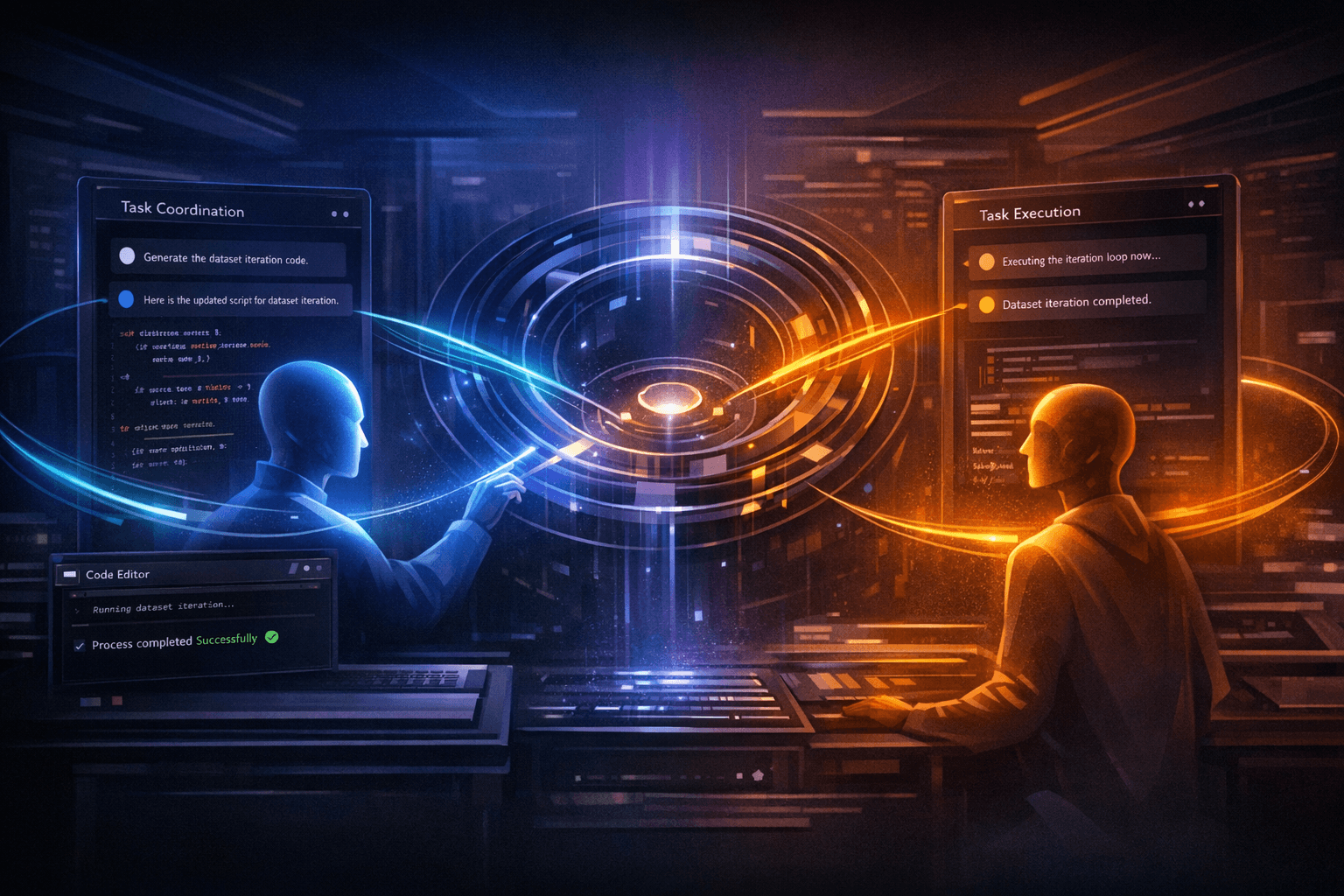
The most credible argument for Gemini orchestrating Claude is not that one model replaces the other. It is that modern development work already contains distinct layers: planning, delegation, repository inspection, code editing, testing, browser verification and summarization. When a system can assign those layers intelligently, cross-model orchestration becomes less of a branding exercise and more of a workflow design choice. That is the angle worth watching in Nic Hyper Flow.
Summary
Two recent documentation trends matter here. Google's agent platform messaging emphasizes orchestration, manager surfaces and subagents that can work in parallel or in isolated contexts. Anthropic's Claude Code documentation emphasizes direct codebase action: reading files, editing code, running commands, using tools and coordinating agent teams. Read together, they point toward a practical architecture in which Gemini acts as a strategic coordinator and Claude acts as an implementation specialist on coding-heavy subtasks.
Nic Hyper Flow makes that pattern legible because it treats agents as operators inside a tool-using environment rather than as detached chat responses. The result is a workflow that developers can reason about in concrete terms: decide, dispatch, execute, verify and report.
What happened
Google's recent writing around agentic development has moved beyond inline assistance and toward orchestration. The Antigravity announcement describes a manager surface where developers can spawn, orchestrate and observe multiple agents across workspaces. The Gemini CLI subagents announcement makes the same point at a lower level: a primary session stays focused on the overall task while specialized subagents operate in isolated contexts and return consolidated results.
Anthropic's Claude Code overview describes a complementary capability set. Claude Code is presented as an agentic coding tool that understands a codebase, edits files, runs commands, integrates with development tools and can spawn multiple agents for parallel work. That makes Claude a plausible execution engine when the task is not only to discuss code, but to act on it.
Inside Nic Hyper Flow, these ideas fit together naturally. A coordinating layer can decide when to keep work in the main session, when to call a specialized subagent, and when to hand a coding-heavy task to Claude. The article-worthy point is not novelty for its own sake. It is the clarity of the separation between orchestration and execution.
Why it matters
Single-model workflows often force one system to do everything equally well: keep the big picture in mind, preserve context, route work, perform tool calls, patch files and produce a final explanation. That can work, but it also creates tension between breadth and depth. A cross-model workflow can reduce that tension if the boundaries are clear.
In practice, this means the orchestrating model can stay responsible for decomposition, prioritization and synthesis, while the executing model focuses on repository-level action. The benefit is not abstract intelligence stacking. The benefit is cleaner operational roles and fewer cases where the main session becomes overloaded with intermediate detail.
The strongest case for model collaboration is procedural: let the coordinator keep the task coherent and let the executor go deep where tools, files and verification matter most.
Cross-model orchestration
A practical workflow might look like this. Gemini receives a broad request such as: investigate a regression, update the relevant UI, run the app, validate the outcome and summarize the change. Rather than handling every step monolithically, it can split the work. One subagent maps the codebase. Another checks documentation or release notes. A Claude-backed coding agent takes the repository edit, command execution and verification path. The orchestrator then gathers the outputs and returns a coherent conclusion.
That pattern is especially useful when tasks contain different cognitive shapes. Planning a multi-step repair is not the same as editing several files safely. Monitoring a long-running tool is not the same as writing the final explanation. By making those differences explicit, cross-model collaboration becomes easier to justify technically.
The distinction also helps with context management. Google's subagent framing emphasizes isolated context windows to prevent the main session from filling up with intermediate noise. Anthropic's Claude Code documentation emphasizes that a lead agent can coordinate multiple Claude agents and merge the results. Nic Hyper Flow can benefit from both ideas: use orchestration to keep the control plane lean, and use execution agents where tool-rich coding work is needed.
Developer impact
For developers, the real test is whether this improves ordinary work. The answer is most convincing in tasks that combine planning and implementation. Consider a Flutter interface issue. Gemini can keep the wider ticket context, acceptance criteria and task breakdown visible, while Claude handles inspection of the widget tree, code edits, terminal commands and validation artifacts. The final result feels less like a generic chatbot answer and more like a managed workflow with accountable stages.
The same applies outside Flutter, but Flutter is a useful example because UI regressions often require fast iteration across screenshots, layout code and verification. An orchestrated setup can keep the top-level objective stable while delegating the code-heavy portion to the model best positioned to operate on the project files.
This does not remove the need for developer judgment. Parallel agents can conflict, poorly bounded subtasks can waste time, and orchestration only helps when handoffs are explicit. Still, the practical value is easy to see: a cleaner division of labor, less context pollution in the lead session, and better use of specialized tool behavior.
Connection to Nic Hyper Flow
Nic Hyper Flow is a natural setting for this model because it already treats agents as tool-using workers rather than as text-only assistants. A coordinating layer can read the task, inspect the repository, spin up subagents, monitor progress, and decide when a Claude-driven coding pass is the right move. That makes the workflow tangible instead of theoretical.
It also keeps cross-model orchestration grounded in deliverables. The system is not merely comparing answers from different models. It is deciding which model should own which stage of work and then leaving behind observable outputs such as file changes, summaries, assets or verification notes. That is a stronger pattern than model switching for its own sake.
In that sense, what feels distinctive is not simply that Gemini and Claude can both appear in one environment. It is that Nic Hyper Flow can present a coherent workflow where Gemini behaves as a coordinator and Claude behaves as a focused executor for coding-intensive tasks, with the final result returned as a single usable package.
Conclusion
Developers evaluating multi-model strategies should probably ignore the more theatrical framing and focus on workflow shape. When Gemini is used as an orchestrator and Claude is used for deep code action, the combination can be easier to justify than a generic “best model wins” narrative. It reflects the fact that software work contains different layers of responsibility.
That is why this Nic Hyper Flow setup is worth watching. It presents cross-model collaboration as a practical division of labor: one system maintains the task map, another executes specialized coding work, and the developer receives a more coherent result than either layer would necessarily provide alone.
Sources
This article was prepared with reference to the following pages read directly before writing:
- Google Developers Blog — Build with Google Antigravity, our new agentic development platform
- Google Developers Blog — Subagents have arrived in Gemini CLI
- Anthropic Docs — Claude Code overview
Frequently Asked Questions
How does Nic Hyper Flow improve mobile debugging?
It allows developers to send screenshots directly from a phone to an AI agent that has full context of the repository, enabling faster diagnosis and code fixes.
Does it support Flutter hot reload?
Yes, Nic Hyper Flow is designed to work with Flutter's hot reload, allowing you to apply agent-generated fixes and see the results on your device instantly.