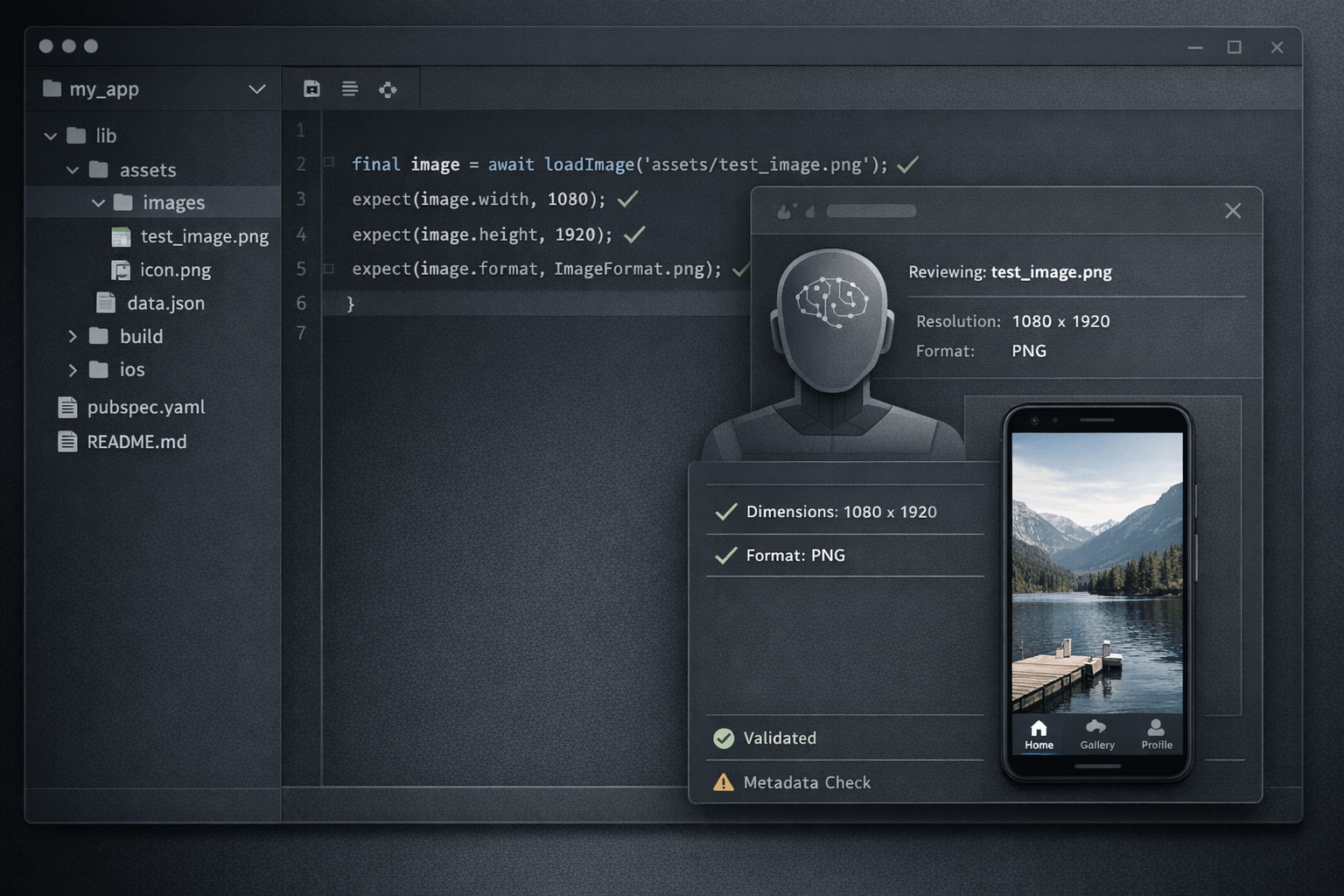
One of the limitations of many image-generation workflows is that they stop too early. An asset is generated, saved somewhere, and assumed to be good enough. In practice, that is not always enough. Teams often need to know whether the saved file itself still matches the intended result, whether it looks usable in context, and whether it is the exact asset that should stay in the repository. That is where reading the saved image back becomes useful.
Summary
OpenAI's image and vision documentation describes how models can analyze images as inputs, whether by URL, base64 or file reference. Flutter's asset documentation explains that application assets are declared in pubspec.yaml and loaded at runtime from the project bundle. Put together, these two ideas point to a practical workflow: once an image is in the repository, it can be treated as a real project artifact rather than a temporary output.
Nic Hyper Flow's get_image tool fits into that gap. It allows the agent to inspect the saved repository asset itself, which makes it easier to verify whether a generated or uploaded image actually fits the intended article, screen or feature.
What happened
The workflow highlighted here is straightforward. An image may be generated by the agent, uploaded from a phone, or already present in the repository. Instead of trusting that the asset is correct just because it was created successfully, the agent can load that exact file back and inspect it again. The important part is that the agent is no longer reasoning from a prompt alone. It is reasoning from the actual saved output.
This makes the visual workflow more grounded. A file path in the repository now points to something the agent can inspect, discuss and validate more directly.
Why it matters
Visual work often fails at the handoff between generation and use. A generated image may be technically valid but compositionally wrong, slightly off-brand, or unsuitable for the article or UI where it is supposed to appear. If the workflow has no way to revisit the saved result, teams either trust it too early or spend extra time checking it manually.
By letting the agent read the repository asset back, Nic Hyper Flow adds a review step that is small but useful. The question becomes: does the asset that is actually saved here look like the asset we intended to keep? That is a more practical question than whether the original generation request succeeded.
Generation is only part of the workflow. For real project use, the saved output is what matters.
Reading assets back
The value of get_image is that it turns a repository image into fresh context. That matters after generation, after compression, after renaming, and after the file is moved into the exact path the project will use. Once the file is in place, the agent can inspect that version rather than an earlier intermediate one.
This is especially relevant when a workflow includes several asset steps: generate the image, keep the compressed version, remove the original, rename the file, and reference it in HTML or code. A post-save visual check helps confirm that the final kept file is the one the project should reference.
Asset quality control
The quality-control benefit is practical rather than dramatic. A content team can use it to verify article covers. A developer can use it to inspect a saved UI illustration or screenshot asset before wiring it into a page. A Flutter workflow can use it to confirm that a bundled image is the right file before it is declared in pubspec.yaml and loaded through Image.asset.
The same idea also supports consistency. If an agent generates an image with one intention but the saved file ends up looking different from what the article, screen or feature needs, the mismatch can be noticed earlier. That reduces blind trust in intermediate steps.
Connection to Nic Hyper Flow
Nic Hyper Flow is useful here because it treats repository assets as part of the real working context. The agent does not only generate images or receive uploads. It can also inspect the files that now live inside the project. That makes image-related workflows feel closer to the rest of development work, where the saved file path and the final artifact matter more than the moment of generation.
This also complements other Nic Hyper Flow flows. A phone capture can become a repository asset. A generated image can be compressed and renamed. A saved asset can be referenced in HTML or Flutter code. And with get_image, the agent can review that final asset directly instead of assuming it is correct.
Conclusion
The interesting part of get_image is not that it is visually flashy. It is that it makes asset workflows easier to trust. Once the agent can inspect the image that is actually stored in the repository, visual work becomes less dependent on assumptions and more tied to the real project state.
For teams working with articles, documentation, Flutter assets or generated visuals, that is a practical improvement. The loop becomes more complete: create or upload the asset, save it where the project uses it, and then inspect that exact saved file again before treating the work as finished.
Sources
The article draws on the following documentation pages read during preparation: